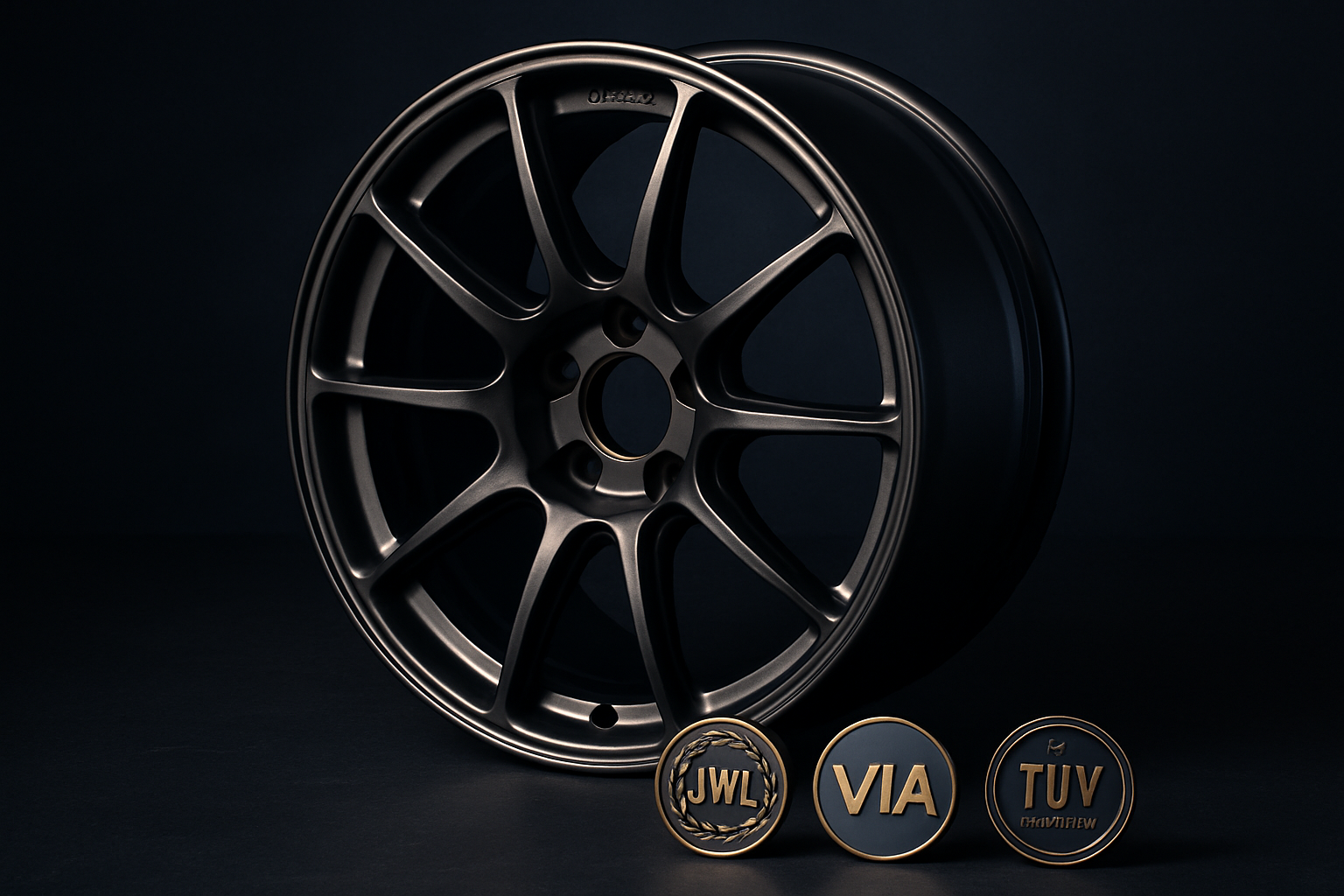
Quick summary: JWL is a Japanese self-declaration standard (mandatory in Japan), VIA adds independent lab testing on top of JWL (harder to fake), and TÜV Rheinland is the German third-party certification accepted across Europe and increasingly required by US importers. AegisRim wheels carry all three.
Why Wheel Certifications Matter for B2B Buyers
If you're sourcing aftermarket wheels for distribution in North America, Europe, or Asia-Pacific, certification isn't just a quality signal — it's increasingly a legal and liability requirement. Customs authorities, insurance companies, and tier-1 automotive groups all ask for it.
Stocking uncertified wheels exposes you to: import rejection, end-customer warranty disputes, and liability in the event of a wheel failure. Getting this right upstream saves your accounts downstream.
JWL — Japan Light Alloy Wheel Standard
What it is
JWL (Japan Light Alloy Wheel) is a self-declaration standard administered by Japan's Ministry of Land, Infrastructure, Transport and Tourism (MLIT). Manufacturers test their own wheels against a defined test protocol and mark them with the JWL stamp if they pass.
What it tests
- Rotary bending fatigue test (simulates cornering loads)
- Radial fatigue test (simulates straight-road impact loads)
- Impact test (simulates pothole strikes at speed)
Key point for buyers
JWL is mandatory for wheels sold in Japan. It's also widely accepted as a baseline quality indicator in Asia-Pacific markets. However, because it's self-declared, a JWL stamp alone does not guarantee independent verification.
VIA — Vehicle Inspection Association
What it adds to JWL
VIA is run by the Japan Vehicle Inspection Association. A VIA mark means the wheel has passed the same JWL test protocol, but the testing was conducted by an independent VIA-certified laboratory — not just in-house by the manufacturer.
Why it's stronger
VIA = JWL + independent third-party verification. For B2B buyers who need proof of quality that can survive an audit, VIA marks carry more weight than JWL alone.
Market requirement: If your customers in Japan or Southeast Asia are tier-1 dealers or fleet operators, they may specifically require VIA (not just JWL). Always check before quoting.
TÜV Rheinland — German Technical Inspection
What it is
TÜV Rheinland is an independent German certification body. For wheels, it performs comprehensive testing that overlaps with JWL/VIA but uses stricter pass/fail thresholds and includes additional tests relevant to European road conditions and vehicle homologation requirements.
What it tests (additional vs. JWL)
- Extended rotary bending fatigue (higher cycle count)
- Cornering fatigue test under biaxial loading
- Dimensional compliance with European fitment standards
- Material traceability documentation
Why it matters for US and European distribution
TÜV Rheinland certification is increasingly demanded by:
- European importers — required for vehicle homologation approval in Germany, Switzerland, Austria
- US fleet operators — especially government fleets and commercial vehicle operators looking for documented safety compliance
- Insurance carriers — some US commercial auto insurers now require TÜV documentation for aftermarket wheel coverage
- Large-format retailers — Tier-1 automotive retailers in the US are beginning to list TÜV as a preferred sourcing criterion
Side-by-Side Comparison
| Certification | Issuer | Test Method | Third-Party? | Markets |
|---|---|---|---|---|
| JWL | Japan MLIT | Bending + radial + impact | No (self-declared) | Japan, Asia-Pacific |
| VIA | Japan VIA | JWL tests + independent lab | Yes | Japan, SEA, Korea |
| TÜV Rheinland | TÜV Rheinland (Germany) | Extended fatigue + biaxial + dimensional | Yes | Europe, US commercial, global tier-1 |
Which Certification Should You Require When Sourcing?
Use this as a quick decision guide based on your end market:
- Selling in Japan or Korea: Require VIA (not just JWL). Self-declared JWL is easy to fake.
- Selling in Germany, Switzerland, Austria: Require TÜV Rheinland. It may be legally necessary for vehicle homologation.
- Selling in the US (retail/enthusiast): JWL + VIA is the current market standard, but TÜV is a strong differentiator and increasingly requested.
- Selling to US commercial fleets or government: Require TÜV documentation. Request the physical test report, not just the mark.
- Selling across multiple markets: Source wheels with all three. That's what AegisRim carries.
What to Ask Your Supplier
When evaluating a new wheel source, ask for:
- The actual test report (not just a certificate scan) — confirms the specific SKUs tested
- The test date — certifications have validity periods; check the wheel model wasn't modified since testing
- The testing laboratory — for VIA, confirm it's a VIA-approved lab; for TÜV, confirm it's TÜV Rheinland (not a different TÜV entity)
- IATF 16949 factory certification — this is the automotive quality management system standard; it doesn't replace wheel testing but signals factory discipline
AegisRim documentation: All AegisRim wheel SKUs ship with full JWL, VIA, and TÜV Rheinland test reports on request. B2B members can request documentation bundles directly through the member portal under New Inquiry → Documentation Request.
Bottom Line
JWL is the minimum; VIA is JWL with proof; TÜV is the global standard for serious distributors. If you're building a wholesale catalogue that can sell into multiple markets and survive customs scrutiny, source wheels with all three — and keep the test reports on file.
Questions? Reply to this article or contact Sales@nexautogear.com.