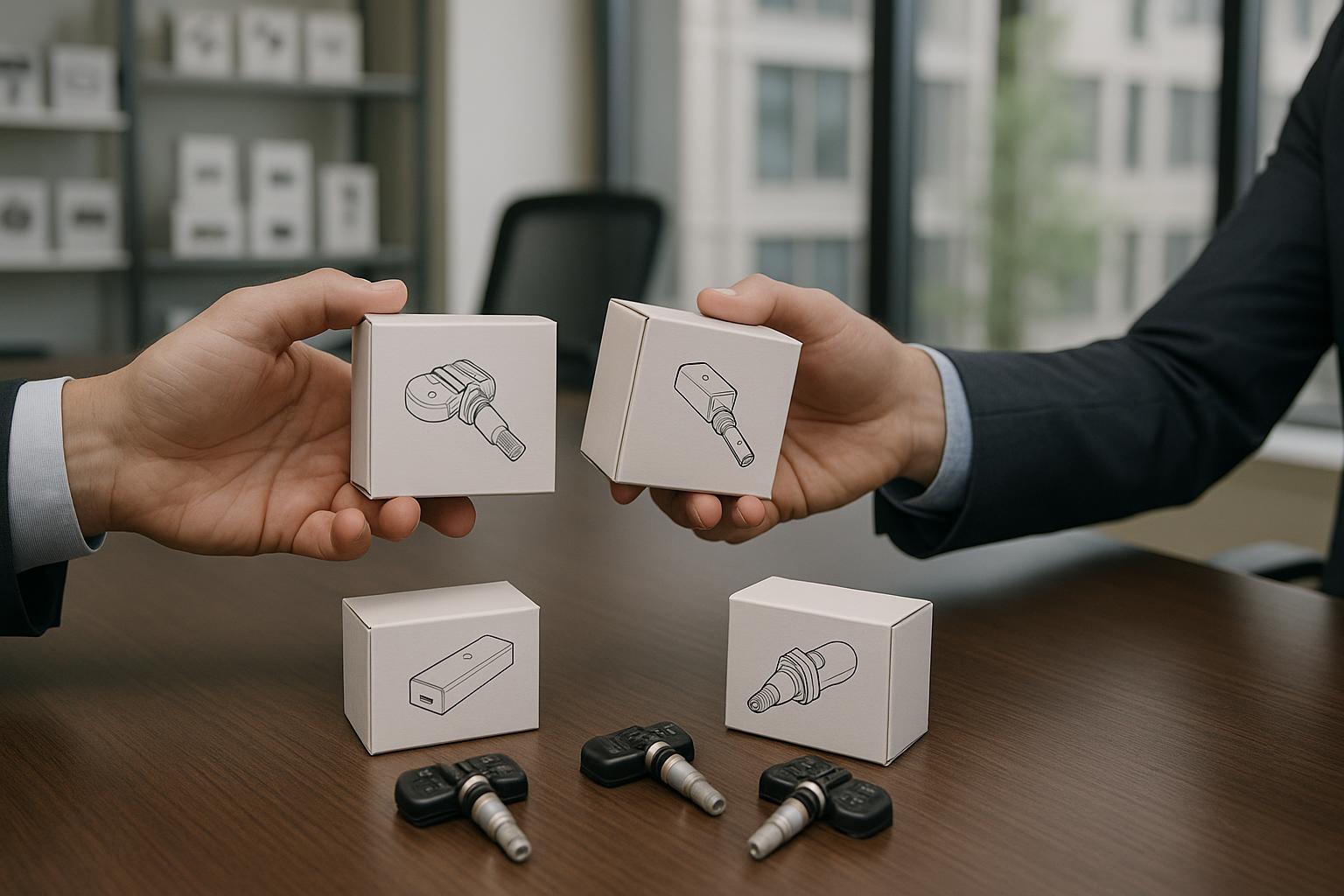
Most tire shops have a go-to TPMS supplier. They've ordered from the same source for two or three years, the price is familiar, and switching feels like unnecessary friction.
Until the callbacks start.
A sensor fails at 9 months. A relearn won't complete on a 2024 model. A shop customer comes back with a dashboard warning light that won't clear. Each of these costs you more in labor and reputation than the few dollars you saved per unit.
The problem usually isn't random bad luck. It's that the wrong questions were never asked when the supplier relationship was set up.
Here are the six questions that separate a reliable TPMS partner from a source of recurring headaches.
1. "Can you show me your production batch traceability?"
Every sensor in a high-quality supply chain carries a batch number and a date code — stamped or printed on the unit itself or on the inner packaging. This isn't decoration. It's how you trace a failure back to a production run, identify whether the issue affects other units in inventory, and hold the supplier accountable.
If your current supplier can't produce this documentation — or gives you vague answers about "factory direct" sourcing — you don't actually know what you're installing.
According to a 2024 analysis by SEMA, counterfeit and untracked TPMS units now represent an estimated 15–20% of the aftermarket sensor supply chain in North America. A batch number is your first filter.
2. "What battery brand is inside, and what's the actual lifespan under real-world conditions?"
The battery is the most common failure point in aftermarket TPMS sensors. A quality unit uses cells from manufacturers like Maxell, Panasonic, or Renata. A cheap unit uses whatever cell passed minimum spec testing at the lowest possible cost.

The difference matters: quality cells last 5–7 years under normal conditions. Low-grade cells can drop below functional voltage within 18–24 months, especially in climates with temperature extremes — like Texas summers.
The vendor claim of "5-year battery life" is meaningless without knowing the cell brand and the testing conditions used to generate that number. A legitimate supplier will tell you the cell manufacturer. Ask directly.
3. "Do your sensors enter a deep sleep mode during shipping and storage?"
This one is less obvious but critical for inventory management.
A TPMS sensor in "awake" mode continuously transmits its signal — typically at 315 MHz or 433 MHz depending on the protocol. If a sensor is active in a warehouse or shipping container for months, it's consuming battery before it ever reaches a customer's vehicle.
High-quality sensors ship in a factory-dormant state and only activate on first installation. Ask your supplier how sensors are stored and what activates them out of sleep. If the answer is "they're already active" or "we don't know," your shelf inventory is aging before you sell it.
4. "What vehicles in this year range does this sensor NOT support?"
A reliable supplier knows their product's limitations. This is the question that separates a technically-capable partner from a sales-first operation.
Every aftermarket TPMS sensor has coverage gaps — vehicle lines it doesn't support, protocols it can't handle, or model-year cutoffs where OEM logic changes. The honest answer includes a specific list or a published compatibility database.
The wrong answer is "it covers everything" or "99% of vehicles" with no documentation.
NHTSA data shows that TPMS system failures contribute to thousands of annual incidents. A sensor that appears to install correctly but sends incorrect pressure readings — or fails to trigger a warning — is worse than no sensor at all. Know the gaps before the car drives off the lift.
5. "How does your team handle a new-year model when the tool databases haven't been updated yet?"
This is where real expertise separates good suppliers from great ones.
When a new model year launches — say, a 2026 platform with a modified protocol — aftermarket tool databases often lag by weeks or months. An inexperienced supplier tells you to "wait for the tool update." A knowledgeable supplier can identify the protocol family the new vehicle uses, confirm whether their sensor handles it through protocol inference, and walk your technician through a manual relearn procedure.
Ask this question and watch how the sales rep responds. If they answer confidently with technical specifics, you've found a supplier who's actually done the work. If they redirect to a spec sheet, you know what you're dealing with.
6. "What's your actual warranty process — not your policy, your process?"
Most suppliers advertise 2-year or "lifetime" warranties. The actual process varies enormously.
Ask specifically:
- Do you require the original packaging to process a claim?
- What's your typical turnaround time for warranty replacements?
- Do you cover the technician's labor if the sensor fails at installation?
- What documentation do I need to provide?
A supplier with a real warranty process answers these questions immediately. A supplier whose warranty is mostly marketing will stall, redirect, or give vague assurances.
For a shop running 20–30 TPMS installs per week, a supplier who drags out warranty claims costs you far more in downtime and frustration than the unit price difference ever saved.
Why This Matters for Your Shop's Reputation
A TPMS sensor failure after installation isn't just a $40 problem. It's a callback, a free labor hour, a customer who tells two other people, and a technician who has to explain why something they installed isn't working.
Consumer Reports data consistently shows that tire-related service failures rank among the top reasons customers switch repair shops. TPMS issues are disproportionately represented in that data because the failure is visible — it shows up as a dashboard warning light that the customer sees every time they start the car.
The sensor you install reflects on your shop. The supplier you choose determines what you're installing.
What to Look For in a Long-Term TPMS Partner
- Batch-traceable inventory
- Named battery cell brands (Maxell, Panasonic, Renata)
- Documented dormant-mode shipping
- Honest coverage gap disclosure
- Technical team that understands protocol logic, not just spec sheets
- A warranty process that's specific and fast
NexAutoGear provides direct-factory TPMS sensors with full batch documentation, technical FAE support, and same-day response to compatibility questions. Our team has 8+ years in TPMS product development — we've seen every failure mode in this category and built our supply chain around avoiding them.
If you're due for a supplier review, contact us for a sample evaluation.
Frequently Asked Questions
Maxell, Panasonic, and Renata are the reference-tier cell manufacturers for TPMS applications. These cells maintain voltage stability across temperature extremes and meet the 5–7 year lifespan that quality sensors are rated for. If a supplier won't identify the battery brand—or gives a generic answer like "Japanese cells"—treat that as a yellow flag. A legitimate supplier knows exactly what's inside their product.
Two checks: First, ask your supplier whether sensors ship in dormant mode (factory sleep state that preserves battery until first installation). If they ship active, inventory sitting in your storeroom is consuming battery. Second, check for a date code stamped on the unit or inner packaging. Cross-reference the manufacture date against your installation date—sensors installed more than 18 months after manufacture have reduced effective battery life, especially if stored in non-climate-controlled conditions.
When a new model year launches with a modified protocol before tool databases update, NEXAutogear's FAE team identifies the protocol family, confirms sensor compatibility through protocol inference, and walks your technician through a manual relearn procedure. We don't tell shops to wait for a tool update—we solve the problem at the protocol level. Same-day response for compatibility questions is standard. Contact us at Sales@nexautogear.com for technical support.
Ready to work with a TPMS specialist? Contact NEXAutogear →
Related Articles
Sources & References
Need TPMS Sensors or Certified Wheels?
Join 2,000+ B2B distributors. Minimum order from 50 units. 8-week lead time.
JOIN B2B PROGRAM →